
CE marking is the marking a manufacturer uses to indicate that a device conforms with the applicable requirements[1]. For medical devices sold in the European Union, the relevant rules are in Regulation (EU) 2017/745, the EU MDR. This guide explains what CE marking means on a medical device, what is required, and the steps manufacturers generally follow to obtain it.
What is CE marking for medical devices?
What does the CE mark mean on medical devices?

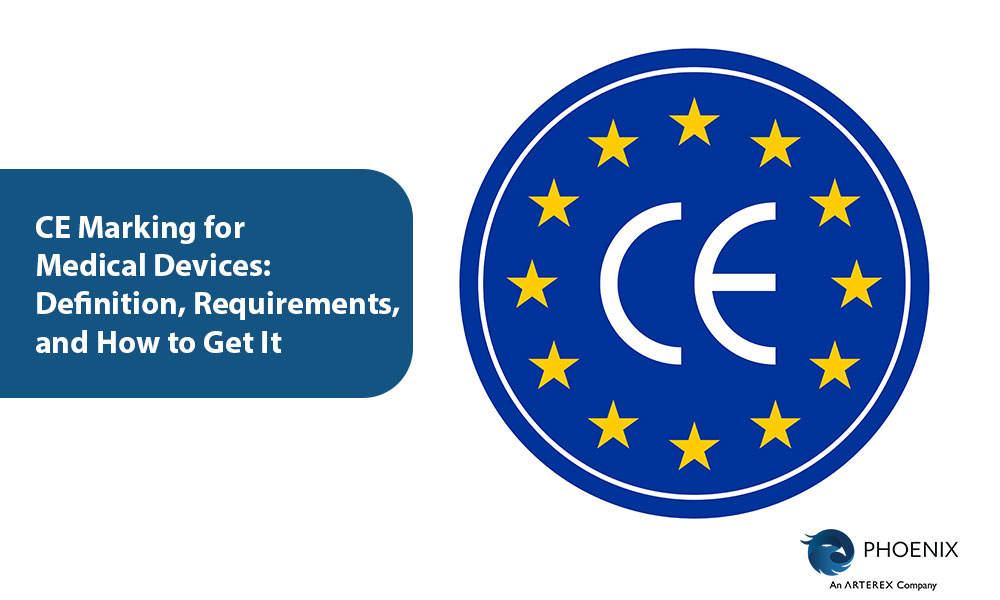
In general, the Commission explains that the CE letters show that products sold in the European Economic Area have been assessed to meet high safety, health, and environmental protection requirements[3]. The same page also clarifies what the mark does not mean. It does not mean the EU or another authority has approved the product as safe, and it does not indicate where a product comes from[3].
Who is responsible for CE marking?
CE marking requirements for medical devices
The MDR places several requirements on manufacturers that sit behind the CE mark:
- A defined medical device. The regulation covers any instrument, apparatus, appliance, software, implant, reagent, material, or other article intended by the manufacturer for human beings for specific medical purposes[1].
- A risk class. Devices are divided into classes I, IIa, IIb, and III based on intended purpose and inherent risks, using the rules in Annex VIII[5].
- A quality management system. It must be proportionate to risk, cover all parts of the organisation, and address items such as a regulatory compliance strategy, risk management, clinical evaluation, and post-market surveillance[1].
- Technical documentation. Manufacturers must draw up and keep up to date technical documentation that includes the elements in Annexes II and III[1].
- Post-market surveillance. Manufacturers must implement and keep up to date a post-market surveillance system[1].
- A person responsible for regulatory compliance. At least one person with the required expertise. Micro and small enterprises do not need to employ this person, but must have one permanently and continuously at their disposal[1].
How to get CE marking for a medical device

The steps below organize the requirements above into a practical order. They are not a sequence set by the regulation itself.
1. Confirm the product is a medical device and classify it
Start with the definition in the MDR[1], then apply the classification rules in Annex VIII. Commission guidance explains that classification is a risk-based system that considers factors such as duration of contact, invasiveness, and energy dependence[5].
2. Put a quality management system in place
Establish, document, implement, and maintain the system required by Article 10(9) of the MDR[1].
3. Prepare technical documentation
Draw up the technical documentation, covering the elements in Annexes II and III, and keep it up to date[1]. The Commission refers to this as setting up the technical file[3].
4. Complete the conformity assessment
The manufacturer carries out the conformity assessment[3]. For higher-risk products, a notified body is involved. The Commission gives class IIa, IIb, and III devices as examples, and notes that the higher the class, the greater the involvement of a notified body[4][5].
5. Issue the EU declaration of conformity
Only the manufacturer can issue it, and it must be drafted and signed by the manufacturer. Minimum content includes the product description, the legislation cited, the manufacturer’s name and address, and the conformity assessment procedure applied[4].
6. Affix the CE mark
The manufacturer affixes the CE marking[3]. Where a notified body is involved, the CE mark is followed by its four-digit identification number[4].
7. Maintain compliance after launch
Keep the post-market surveillance system up to date. If a device does not conform, the manufacturer must immediately take the necessary corrective action, which can include withdrawal or recall[1].
Notified bodies and CE certificates
The Commission’s guidance on verifying conformity documents makes several points that are useful to know:
- Notified bodies issue two types of certificates, product certificates and quality management system certificates[4]
- Only bodies listed in the NANDO database are entitled to issue valid certificates, within their scope and competences[4]
- Notified bodies cannot issue any certificate based on test reports only[4]
- The notified body’s identification number must also appear clearly on the certificate[4]
Common CE marking mistakes to avoid
- Relying on a document that is not a declaration of conformity. Valid declarations can only be issued by manufacturers, and other documents such as certificates of compliance or test reports cannot replace it[4]
- Assuming a notified body certificate can rest on test reports alone[4]
- Treating the CE mark as proof of regulatory approval. The Commission notes it does not mean the EU or another authority has approved the product[3]
CE certificates issued under the earlier directives
Certificates issued under Directives 90/385/EEC and 93/42/EEC that were valid on 26 May 2021 and not withdrawn afterwards remain valid beyond the date on the certificate until set dates for each risk class, subject to conditions. Those dates are 31 December 2027 for class III devices and class IIb implantable devices (with listed exceptions), and 31 December 2028 for other class IIb devices, class IIa devices, and class I devices that are sterile or have a measuring function[2].
Working with a manufacturer familiar with EU requirements
Phoenix Biomed, based in Modena, lists an ISO 13485:2016 certificate and an MDR certificate titled “EU Quality Management System Certificate” on its certifications page[6]. The company also lists ISO 8 clean-room facilities[7]. Because the CE marking responsibilities described above rest with the manufacturer, device teams should confirm with their quality and regulatory teams how responsibilities are divided in any manufacturing relationship.
Frequently asked questions
What is CE marking on medical devices?
What does the CE mark mean on a medical device?
It shows the product has been assessed against the relevant requirements. It does not mean the EU or another authority has approved the product as safe[3].
Who can issue the EU declaration of conformity?
Only the manufacturer[4].
Do I need a notified body to get CE marking?
It depends on the device. The Commission states that notified body involvement is required for higher-risk products, with class IIa, IIb, and III devices as examples[4]. Confirm the route for your device with your regulatory team.
What is the number next to the CE mark?
Where a notified body is involved, the CE mark is followed by its four-digit identification number[4].
Can a test report replace a CE certificate?
No. Notified bodies cannot issue any certificate based on test reports only, and test reports cannot replace the declaration of conformity[4].
Related reading
For US context on device risk classes, see Phoenix Biomed’s guide to Class II medical devices, and for development stages, Medical Device Development Process.
European Union Medical Device Regulation
•
October 23, 2026
What To Know About European Union Medical Device Regulation? The European Union Medical Device Regulation, known as the EU MDR […]
- What is CE marking for medical devices?
- What does the CE mark mean on medical devices?
- Who is responsible for CE marking?
- CE marking requirements for medical devices
- How to get CE marking for a medical device
- Notified bodies and CE certificates
- Common CE marking mistakes to avoid
- CE certificates issued under the earlier directives
- Working with a manufacturer familiar with EU requirements
- Frequently asked questions
- Related reading
- Sources